
DIY Low-Key Product Photography: Engineer Dramatic Chiaroscuro with Simple Light


Have you ever looked at a photograph of a luxury watch, a sculpted piece of metal, or a meticulously crafted spirit bottle and wondered why your own DIY product photos look so... flat?
It’s the frustration of "good enough" photography. You point your phone, the light is on, and the image is visible. But visibility is the enemy of impact. If you're a small business owner who creates products with passion, your imagery must communicate that same level of intentionality, achieving that desirable dark and moody photography style.
To mix metaphors a bit, “music”, as my professor once told me, "is the space between the notes!" In photography, my approach is that light has no definition without shadows. You don’t need to understand the physics of it (yet!), but you must understand the principle: The closer the light is to your subject, the darker your shadows will be.
The secret to professional, dramatic product photography—the kind that makes a product pop off the screen with sculptural quality, is not expensive gear. It’s about control and Seeing, not just looking.
When Your Product Photos Look "Good Enough", Sales Suffer
Amateur photography relies on soft, ambient (available) light, typically from a window or overhead light. Beautiful soft light definitely has its place, but not when drama is the goal for low-key product photography. This light is diffused and hits the subject from multiple angles, eliminating defining shadows. While critics call this "nice" or "soft," the potential customer sees it for what it is: flat, bland, and devoid of form.
When light hits a subject evenly, you lose three critical elements:
Tactile Texture: Shadows reveal the grain, the polish, and the edges, delivering tactile texture product photography.
Form: Without contrast, a three-dimensional object collapses into a two-dimensional shape.
Emotional Pull: Drama is built on tension—tension between light and dark.
The Engineering Connection: Precision Over Chance
In any precision manufacturing operation, an instruction to "cut to a depth" must be executed perfectly. You don't guess the parameters; you program the exact sequence.
Professional lighting is the same. It is a precision operation. Every angle, distance, and shadow boundary is intentional, not a guess. To create drama, you must stop being a hobbyist and start being an engineer of light.
The Professional Secret: Calculated Shadow (The Physics of Chiaroscuro)
To sculpt your product and create the powerful contrast that demands attention, you must master Chiaroscuro—the technique of using high contrast between light and dark to sculpt form.

The Inverse Square Law: The Tool That Engineers Your Drama
Chiaroscuro is the aesthetic goal; the Inverse Square Law (ISL) is the technical term for property of light that enables us to achieve it.
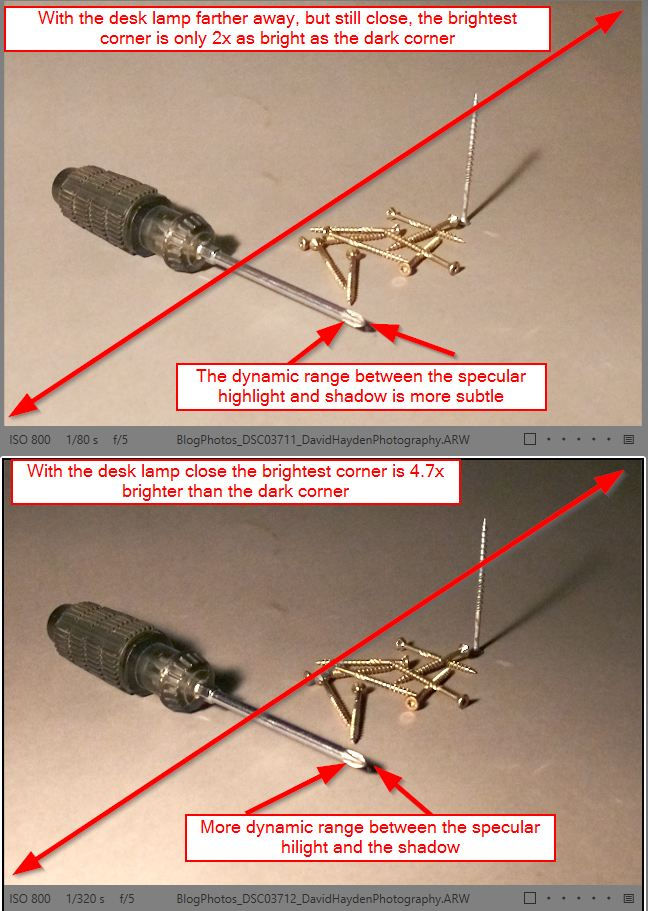
The Inverse Square Law states that the intensity of light drops off exponentially as the distance from the source increases. This means the distance between the light source and the subject is the key to engineering high-contrast images.

To translate this physics into product impact, observe how a subtle movement of the light dramatically alters contrast:
Three Precise Steps to Engineer Dramatic Shadows with Minimal Gear
You can start applying this professional technique right now using a single, cheap light source.
Step 1: Get the Light Close (Maximize the Drop-Off)
Use a single, harsh light source, like the LED on a phone, a cheap desk lamp photography setup, or even a small flashlight.
Instruction: Position the light source inches away from the product, not feet, just outside the frame of the image.
Your reasoning and/or intention: By positioning the light source very close, you use the Inverse Square Law to maximize the difference in intensity between the highlight side and the shadow side of your product.
Goal: Make the front of the product bright and the back side drop into immediate shadow.
Step 2: Distance the Background (Maximize the Contrast)
You need to create physical separation between your product and the background.
Instruction: Push the background (a wall, a piece of cardstock, a cloth) as far away from your subject as possible. Even 1-2 feet can make a massive difference.
Your reasoning and/or intention: This is the second application of ISL. If your background is twice as far from the light as your subject, the background receives only 25% of the light intensity hitting your product. This separation manufactures the deep contrast.
Step 3: Sculpt the Light (Use the Snoot-Hack)
Professional photographers use tools like snoots, barn doors, and optical snoots to restrict the light beam to a specific area. You can emulate this control.
Instruction: Take a piece of black cardstock, construction paper, or even cut the cardboard from an empty cereal box. Roll it up into a tight tube and attach it around your light source. SAFETY FIRST - Never wrap paper around a lamp with any bulb that gets hot. It's not good practice to burn yourself or start a fire.
Your reasoning and/or intention: This "Snoot-Hack" eliminates unwanted light spill. Light is restricted to a small, focused beam that only hits the product, maximizing the blackness of the background and concentrating the energy on the subject.
When to Stop DIY-ing and Start Mastering
Applying the engineering of light (Steps 1-3) will immediately elevate your product photography from flat snapshots to more dramatic, intentional images. You will achieve DIY-Level Drama.
However, DIY control can only take you so far. True Hyper-Real impact, the kind where light is sculpted like clay and every reflection is placed with the precision of a high-end etching, requires not just precise control but often more sophisticated gear.

My work is the result of years of mastering these technical nuances, viewing light not as a creative option, but as a mathematical constant to be controlled. If you want Calculated Precision and Unforgettable Impact for your brand that moves beyond the DIY phase, it’s probably time to hire a photographer who thrives on the engineering of light.
If you are ready to see what true, engineered control looks like, please review my
STILL LIFE portfolio.
If you have questions or seek professional photography to up your brand you us my contact form. CONTACT


Comments